


Terms of Service | Copyright © 2026 Diamond Willow Advisory All Rights Reserved. | Website Design by Woods



A gut check for owners considering selling their business to management.


This guide is designed for business owners considering how best to exit their company and how a management buyout compares with the alternatives.
We’ll walk through the process step by step, from establishing a valuation and assessing management through to structuring the deal, securing bank financing and understanding the risks that can remain long after the sale closes.
Nearly one in five Canadian SME owners expect to exit within five years, representing over $300 billion in annual revenue. For many, the decision goes beyond sale price, with protecting employees and finding the right buyer almost as important as the financial outcome.
exit

1 in 5
owners plan to exit their business within the next 5 years.
BDC Survey, 2023



90%
protect current employees


84%
get the highest possible price
84%
find a value-aligned buyer

77%

maintain the business legacy
73%

keep the business independent
72%

protect the company culture
66%

support the community
What this means
An MBO can deliver on what matters most: continuity, people, and purpose. But it comes with financial trade-offs that need to be understood and managed.
The right structure today protects your priorities tomorrow.
Sources: BDC, Succession + Transition Report 2023 | National Bank, The Owner’s Journey 2022 (Angus Reid)

It offers the opportunity to realize the value they’ve built while preserving continuity and giving trusted people a chance to take ownership. But those benefits can come with a lower price, less cash at closing and continued financial exposure after control changes hands.

Diamond Willow is a Canadian corporate debt advisor, helping companies secure debt financing between $5M and $50M through a network of more than 400 banks and private lenders.
We help finance MBOs by aligning owner objectives, management priorities and lender requirements into a structure banks can support. By balancing risk and debt capacity, we can improve financing options and terms while reducing the risk of overextending the business.
A confidential, no-commitment conversation to understand your priorities and assess the financing structure before the key terms are fixed.





The type of buyer you choose affects the price, how much cash you receive at closing, how long you wait for the balance, how much risk you keep, and what happens to the company after you leave.

Outside buyers generally optimize for price, liquidity, and a cleaner exit, while inside buyers more often optimize for continuity, succession control, and preserving the business’s people, culture, and independence.








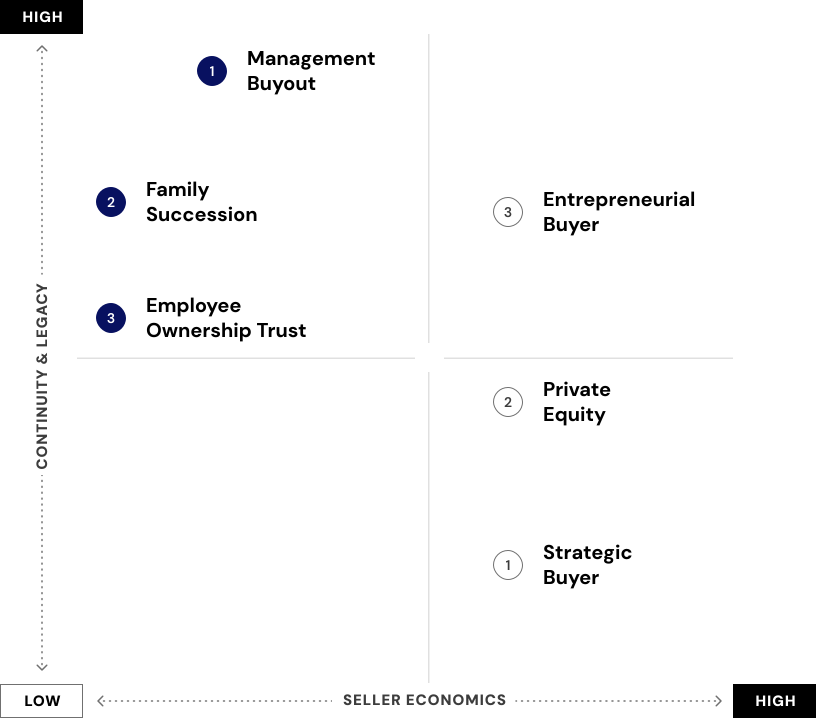


If your priorities are the highest price, the most cash at closing and the least continuing risk, a management buyout is usually not the strongest option.
Management often has less capital than an outside buyer, which can mean a lower purchase price, less cash at closing and a meaningful portion of the proceeds left owing to you for years.

You consider an MBO because you care who owns the company next. Management already knows the business, its customers and its people, and selling to them can preserve much of what you built while giving the people who helped build it a chance to own it.
The trade is that you may give up some financial upside while continuing to carry risk after you have given up control. That does not make an MBO a bad deal. It means you should make the decision with a clear understanding of what you are exchanging for continuity.



Blair Cook, CPA, MBA
Senior Director, Diamond Willow


You know how your management team performs as employees, but ownership asks more.


They will have final authority over the company while putting their own capital, future income and potentially personal guarantees behind the decisions they make, so operating competence alone is not enough.
The opportunity can look attractive until management sees the purchase price, required equity, guarantees and debt obligations attached to it. Some strong managers may decide they would rather remain employees than put their savings and future income behind the business, and they should be able to reach that conclusion without damaging their careers.
For those who remain interested, assess whether they understand how ownership changes the stakes. A lost customer, major investment or difficult personnel decision feels different when personal wealth and debt repayment depend on the outcome.

Look beyond daily operations to capital allocation, major negotiations, senior hiring and firing, lender relationships and periods when the company performs below plan.
The strongest evidence is that those relationships already function under management without requiring you to step back in.
Management should have a credible view of what they will preserve, where they will invest and how they intend to operate the business once the decisions are theirs. If you are financing part of the sale, you are also relying on that plan to repay you.
Some transition period may be sensible, but the business should not depend indefinitely on the person who has supposedly left.

One practical test is to step away for an extended period and give management enough authority to run the company without routine access to you.
Three months away will expose dependencies that are easy to miss while you’re still available to answer questions or intervene. Management doesn’t need to run the company exactly as you would. They need to want the responsibility, understand the financial risk, and prove the business can succeed without you.
Section 04
What is your business worth?


In a management buyout, seller financing can account for as much as 40% of the purchase price, and that money typically sits behind the senior lender in the capital structure.

If the business is valued beyond what its cash flow can support, the financing gap usually gets pushed into more debt, more seller financing, or a repayment schedule that leaves the company with less room to absorb a weaker year. For a seller whose vendor note sits behind the bank, that can mean accepting more exposure to the same business that must generate the cash required to pay them.
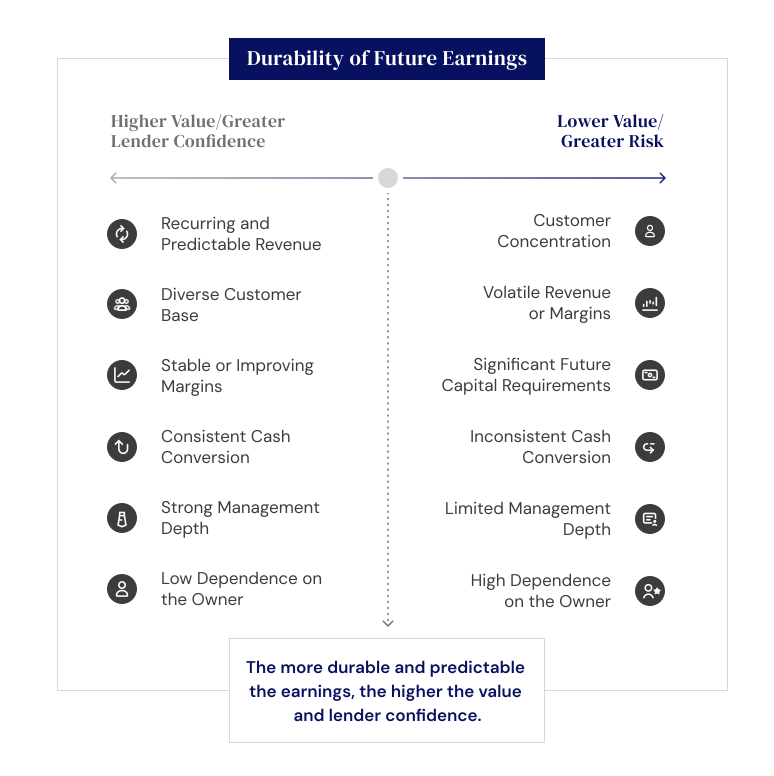
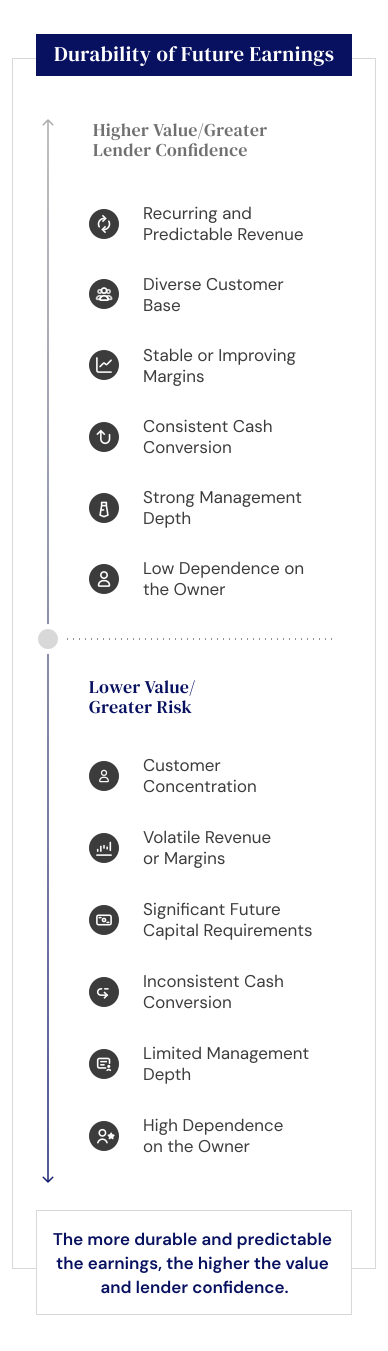
Industry multiples are useful for establishing a range, but they are more a reference point than a valuation. Unlike comparable home sales, two businesses in the same industry can deserve very different multiples once a lender considers earnings durability, customer concentration, capital requirements, management depth and owner dependence.
The more certainty you can establish around future earnings, the more confidence both you and the bank should have that the purchase price is supportable and that the debt, including your vendor note, can be repaid in full. That means being able to explain not only what the company earned historically, but why those earnings should continue after ownership changes.

A valuation multiple is ultimately a judgement about risk. Two companies with the same EBITDA can command very different values depending on how confident a buyer is that those earnings will continue after the transaction.
In an MBO, many of the same characteristics that support a higher valuation also give the bank greater confidence in lending against it.
What the business can support
Valuation establishes what the business may be worth. Repayment capacity determines how much of that price can be financed.

Grant Daunheimer, CFA
Partner, Diamond Willow

Start by gathering the information that explains how the business operates and where its obligations sit:

Five years of financial statements and tax returns
Current management reporting and forecasts
Customer concentration and major contracts
Asset and equipment information
Existing debt, leases and other material liabilities
Corporate records and ownership information
Industry multiples are a reference point, not a valuation. Two businesses in the same industry can justify very different multiples based on their earnings, customers, capital needs, management and owner dependence.
Your accountant should help reconcile reported earnings to a defensible view of normalized EBITDA, including support for one-time adjustments, owner compensation, related-party items and recurring capital requirements. They should also help make sure the forecast is consistent with the company’s historical performance and underlying cash flow.
For a larger or more complex transaction, this work may eventually develop into a more formal Quality of Earnings review.


Your lawyer should review the corporate records, shareholder arrangements, material contracts, existing security and any change-of-control provisions that could affect the transaction. The purpose is to identify legal issues early enough to fix them before they become conditions to financing or problems during diligence.
Because you are underwriting a significant portion of the acquisition yourself, the financial model should be tested with much the same discipline a bank will apply. It should connect the company’s historical performance with management’s forward-looking strategy.
Then, test whether the business can service the acquisition debt and your vendor note while continuing to operate and reinvest. This modelling often reshapes a transaction before lenders are approached, exposing weak assumptions before they reach a bank’s credit process.

Inputs
Historical Financials

Management Strategy

Revenue & Margin Assumptions

Working Capital Needs

Capital Expenditure Plan

Debt & Vendor Note Terms

What to test

Worst-Year Downside Case

Cash Flow After Debt Service

Ability to Repay the Bank

Ability to Repay the Seller

Enough Capital to Operate & Invest

Impact of Weaker Results or Higher Rates

A good model should test the deal without rose-coloured glasses
Preparing this model is partly about giving the bank enough evidence to underwrite the acquisition, but it also gives you a clearer view of the risk you’re taking on. If the downside scenario shows more risk than you’re comfortable carrying, the bank will likely reach the same conclusion, and it generally has less flexibility to compromise.
At that point, you may need to lower your expectations on price, change the structure, or decide whether you’re willing to absorb more risk than an outside buyer might require.
/01
If the company repeated its worst year of the last five, could it still meet its obligations to the bank and to you?
/02
After funding the acquisition, will management have enough working capital to execute its plan and invest in the business?
/03
If performance falls short or senior debt is refinanced on worse terms, how much pressure can the business and your own finances absorb?
Section 05

How will the deal be structured?

By this point, you have a view of what the business is worth and its ability to service the debt needed to finance the acquisition.

Structure determines how the remaining purchase price gets funded, when everyone gets paid and who carries the risk if the business does not perform as planned.

Management teams pursuing an MBO often have limited cash relative to the value of the business they want to buy.
Both you and the bank will still want them to have meaningful skin in the game, whether through personal capital, guarantees, or collateral, because the issue is not only how the debt gets serviced, but whether risk and incentives are aligned once ownership changes.
Case in point
See how Diamond Willow financed an MBO where the seller required the buyer to put his home up as collateral, even though it had no material impact on whether the financing would close, because he wanted the buyer to have meaningful skin in the game.
Read the case study

Illustrative Only
Once the purchase price is divided between management, the bank, and you, each party ends up in a very different position.
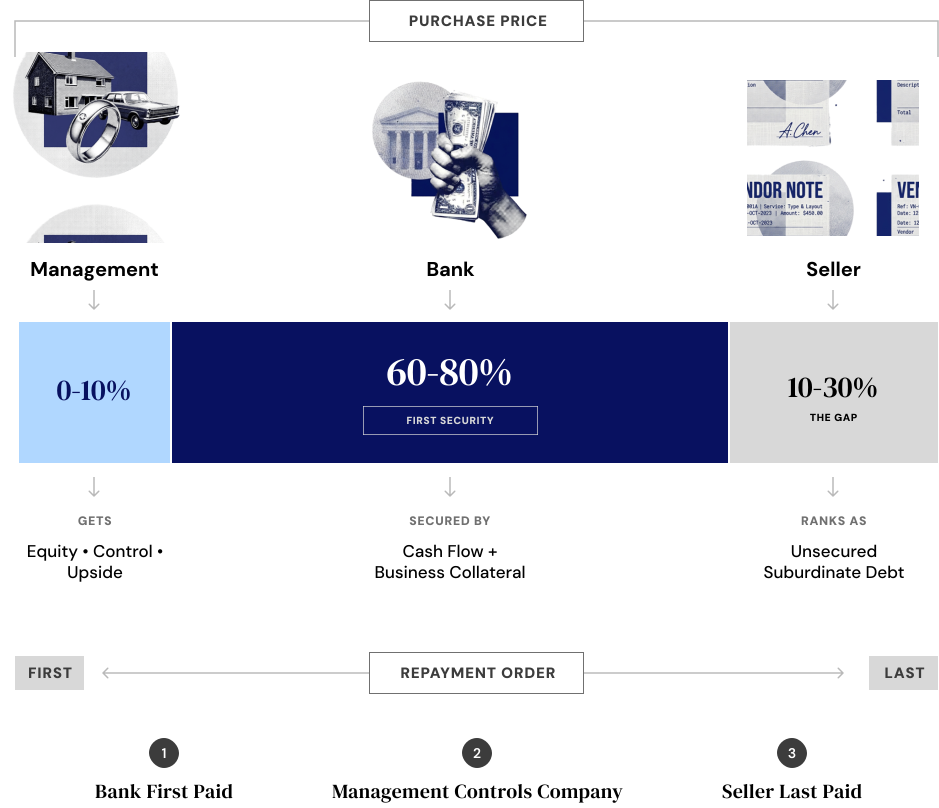
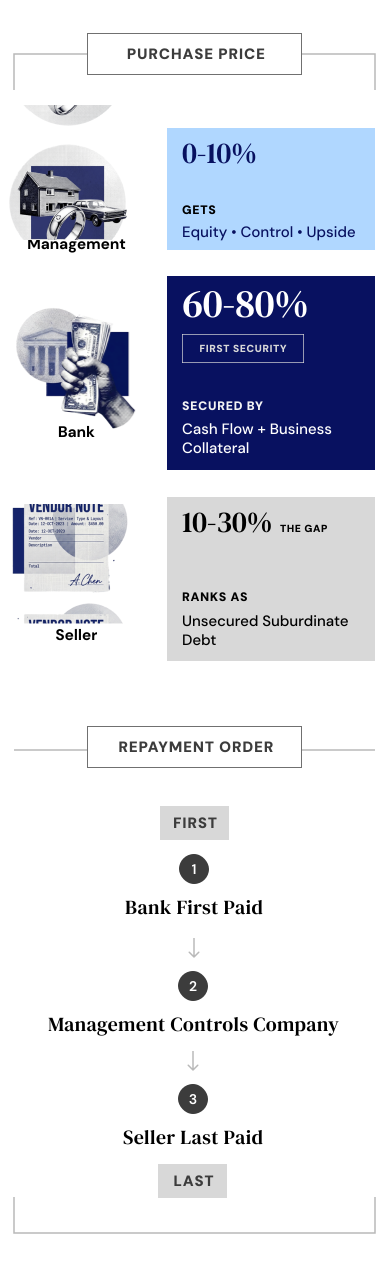
Management controls the company and participates in its future upside, while the bank protects its loan through first-ranking security over the business and repayment terms that give it priority if performance deteriorates. Your vendor note generally sits behind the bank, leaving you with capital still invested but less security and control.
Payments may also be restricted if the company breaches its senior lending terms. How the note ranks, when it gets paid and what protection you retain ultimately determine your risk after ownership changes.
Talk to your lawyer
The legal structure of the acquisition can affect this allocation as well, particularly where the assets, liabilities or security available to the bank differ depending on how the transaction is completed. Work through those decisions with your legal and tax advisors while the financing structure is still being shaped.

Once ownership transfers, most of the upside belongs to management, while your return on the vendor note is limited to repayment of principal and the interest you negotiated.
Because that note generally ranks behind the bank and may be restricted from receiving payments when the senior loan is in trouble, the terms should reflect the amount of risk you’re being asked to retain.
That means looking beyond the headline purchase price and deciding whether the repayment period, interest rate and protections attached to your note are reasonable for the position you’ll hold after closing. If management is receiving control with relatively little capital at risk while you continue to finance a large portion of the purchase price from a subordinated position, the structure deserves another look before you fix the terms.
Section 06

Who will finance the deal?

By now, you’ve worked through the value of the business, tested what it can afford and arrived at a structure that divides the purchase price and risk among management, the bank and you.

The next step is finding the right lender for your deal who’s willing to cut you a cheque.
Canada has a much broader lending market than the major banks, with different lenders prepared to accept different levels and types of risk. For an MBO, it’s useful to think of this market as a spectrum.
Conventional bank financing sits at the lowest-cost end, while government-backed and specialized lenders like BDC and credit unions offer different mandates. Private or alternative credit provides greater flexibility, but at a higher cost.

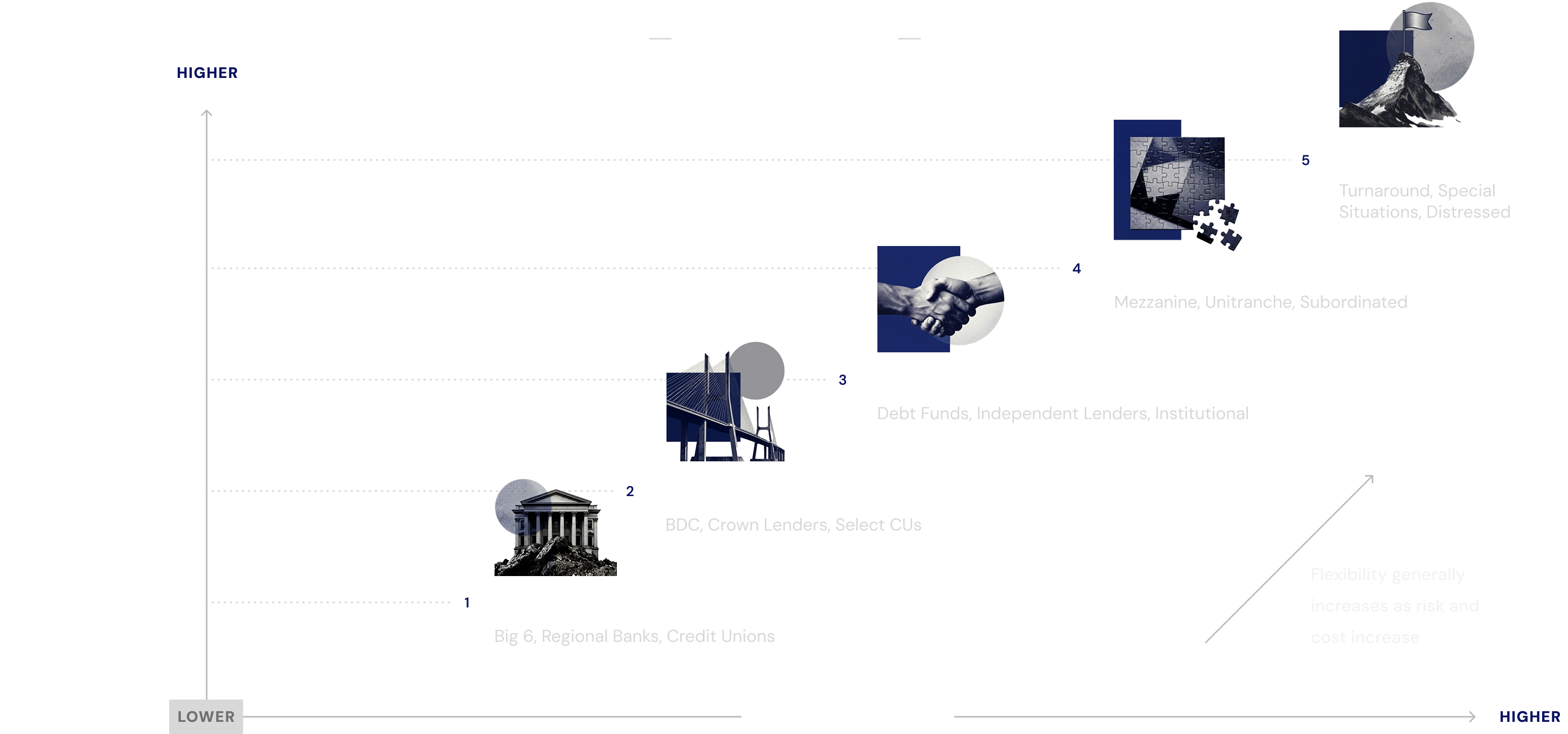
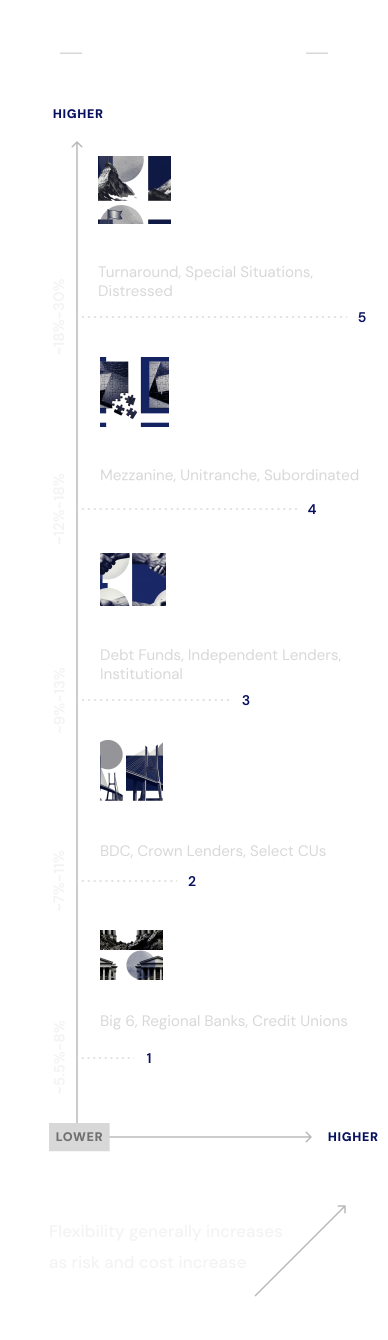
The spectrum
As you move across that spectrum, the trade generally shifts from lower-cost capital with tighter lending parameters toward more expensive capital that can accommodate structures a conventional bank may not accept.

By the time you approach a lender, you should be able to explain the transaction, defend the valuation and structure, and show how the business will service the acquisition debt. Unanswered questions, unsupported adjustments or inconsistencies in the numbers rarely work in your favour because they give the lender more reasons to question the assumptions behind the request.
Most of the underlying work should already be done. The financing package brings it together in a form the lender can review efficiently and should include:
The financing request and proposed capital structure
Historical financials and normalized EBITDA analysis
A forecast showing the company’s ability to service the acquisition debt
Management’s ownership, operating and transition plan
A sources-and-uses schedule showing how the purchase will be funded
An organized virtual data room containing the financial, legal and operating information that supports the case
The bank will test all of this during diligence, so it is better to resolve loose ends before the package goes out than to explain them after a lender has already started questioning the deal.
Your existing bank is usually the best place to start because it already knows the business, has years of transaction history and understands how the company has managed its existing obligations.
That familiarity can make the underwriting process easier and gives the bank more context than a lender seeing the company for the first time.
The broader banking relationship also matters. Commercial banks earn revenue beyond the loan through deposits, treasury services, foreign exchange and other banking products, so they may consider the relationship as a whole. That history can help, but it won’t overcome a transaction that falls outside the bank’s credit mandate.
In Diamond Willow’s experience, a bank decline doesn’t necessarily mean the acquisition can’t be financed. Often, the proposed structure or request simply doesn’t fit the bank’s lending mandate.
Understand Why
Ask the bank to be specific about what drove the decision so you can separate a problem with the business from a problem with the proposed structure or the lender’s own mandate.
Fix the Structure
Major banks tend to work within similar credit parameters, so taking the same unresolved request from one institution to another can produce the same result while weakening the process’s credibility.
Find the Right Lender
At that point, assess which lender is prepared to accept the additional risk and tailor the financing case to that mandate rather than simply shopping the same deal more broadly.


Private credit can make sense when the transaction can’t reasonably be adjusted to fit conventional bank financing, and the value of preserving the agreed structure outweighs the additional cost of capital.
Its flexibility can accommodate higher leverage, weaker collateral or terms that a bank won’t accept, but that flexibility should solve a problem worth paying for.
It makes less sense when a modest change to price, seller financing, repayment terms or security would bring the deal back inside conventional bank parameters. In those cases, paying a materially higher rate to preserve an otherwise adjustable structure can destroy value unnecessarily, particularly if the seller is already carrying a meaningful portion of the purchase price.
Section 07

What happens during due diligence?
A financing approval gets the transaction close to the finish line, but the economics can still change before money moves.


Anything they uncover can affect how much the bank will lend, the security it requires, the repayment terms or the amount of seller financing left with you.
The interest rate is only one part of the offer. Before you agree to the financing, make sure you understand the terms that will affect the company after closing and, where you’re carrying a vendor note, your own ability to get paid.

/01
Amount available
How much of the purchase price will the bank fund, and does that leave you financing more of the transaction than expected?
/02
Pricing and fees
Understand the interest rate, lender fees and other costs attached to the facility rather than comparing the headline rate alone.
/03
Repayment
Amortization and maturity determine how quickly cash has to leave the business to repay the bank. A longer repayment period can reduce annual debt service, while the lender may push for faster principal reduction to lower its exposure.
/04
Covenants
These are the financial limits the company has to remain inside after closing. Pay attention to how much room the business has if results fall below plan.
/05
Security and guarantees
Confirm which business assets secure the loan and whether management is being asked to provide personal guarantees or collateral.
/06
Seller-note restrictions
If your vendor note ranks behind the bank, understand when you’re allowed to receive payments and what circumstances give the senior lender the right to restrict them.

An MBO can streamline diligence because the buyer is already inside the business. … With the right legal strategy and negotiation, sellers may be able to secure a more limited indemnity package and narrower representations and warranties than would typically be expected in a sale to an arm’s-length third party.”
Partner, Cassels
Reach out to Winta on LinkedIn
Once the term sheet is accepted, expect due diligence to feel more like an audit than a confirmation. Over several weeks, the lender and its advisors will review the financial, legal, tax and security details behind the transaction, with professional costs potentially reaching six figures depending on complexity.
If there is a material issue you haven’t disclosed, this is where it will likely surface. Undisclosed liabilities, related-party transactions or other surprises can cause the lender to change its terms or walk away after significant time and money have been spent. Get the skeletons out of the closet early. Finding them during diligence can blow up the deal.
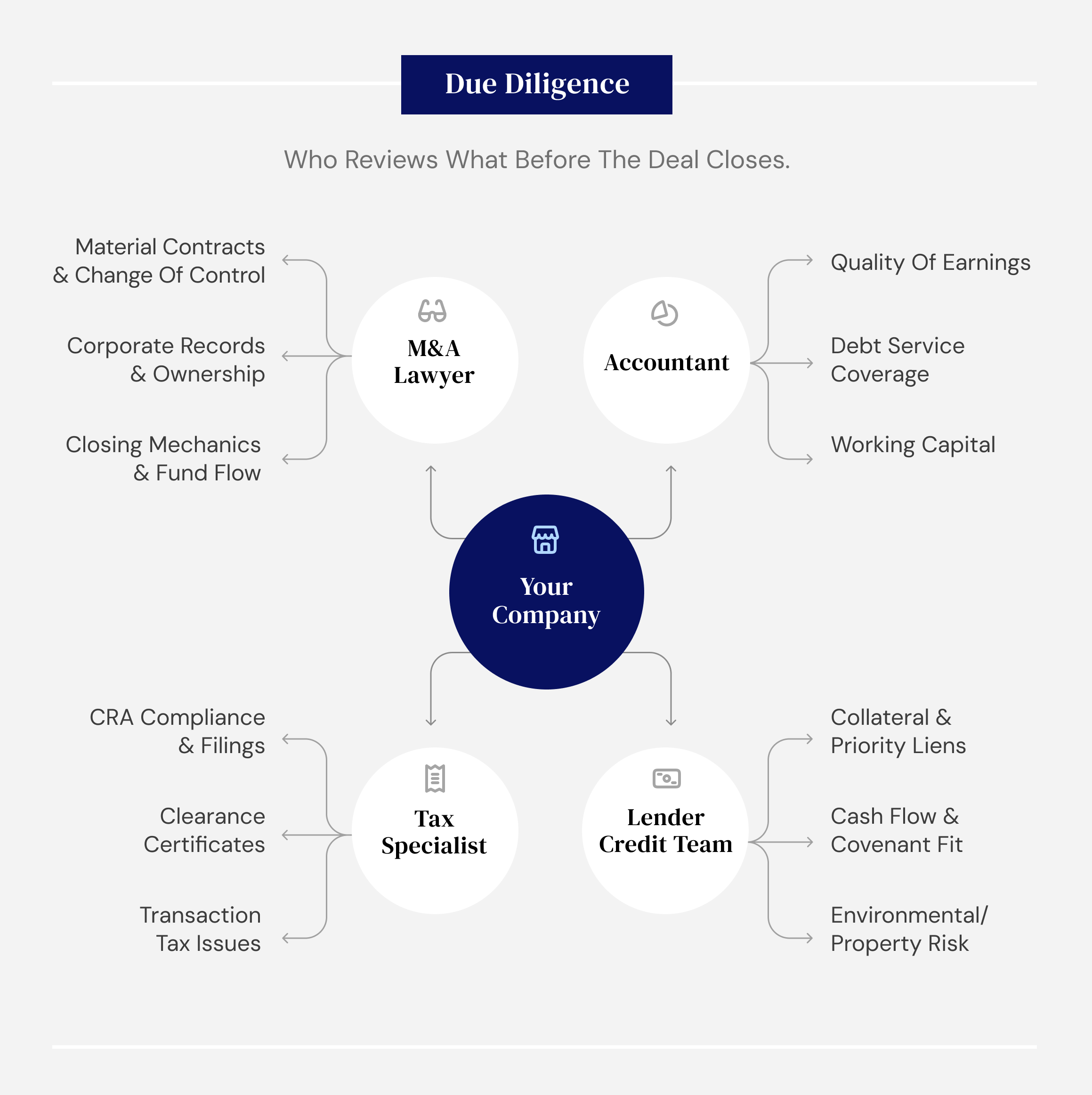
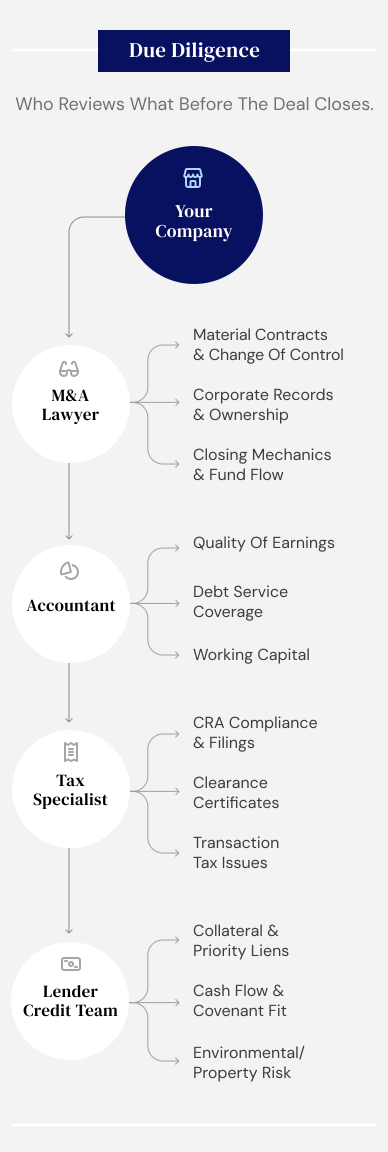
Due diligence gives the lender more information than it had when the term sheet was issued, and it will stress-test the model before converting those indicative terms into final documents.
If its view of the risk changes, expect it to revisit the amount advanced, pricing, amortization, covenants, security or restrictions on your vendor note, including terms you may have assumed were already settled.
Go into that process knowing where you have room to move and where you do not. Before the final documents are signed, return to the objectives that led you to choose an MBO in the first place and make sure the transaction you are closing still delivers the price, cash at closing, seller exposure and succession outcome you were prepared to accept.
Section 08

How will you get paid?

Although the balance owing will naturally get most of your attention, the terms around that balance determine how and when you are paid, particularly if the company falls outside its covenants while your note is still outstanding.
A repayment schedule that looks acceptable on paper can behave very differently once the senior lender’s rights are applied, so make sure you understand:
Interest rate
Confirm the return you will earn while the balance remains outstanding.
Repayment and maturity
Understand when principal starts coming back to you, how quickly it amortizes and when the remaining balance is due.
Security and subordination
Know where your note ranks behind the bank and what, if anything, secures your position.
Payment restrictions
Understand when the senior lender can block or defer payments because of a covenant breach or other default.
Default rights
Be clear about what remedies remain available if management or the company fails to meet the terms of the note.
While your vendor note remains outstanding, you should have enough visibility to know whether repayment is on track without continuing to run the business from the sidelines.
The note and related agreements can require regular financial reporting, notice of covenant breaches or defaults, and other information that gives you an early view of problems that could affect repayment.

Illustrative paths for a seller’s vendor note after an MBO closes.
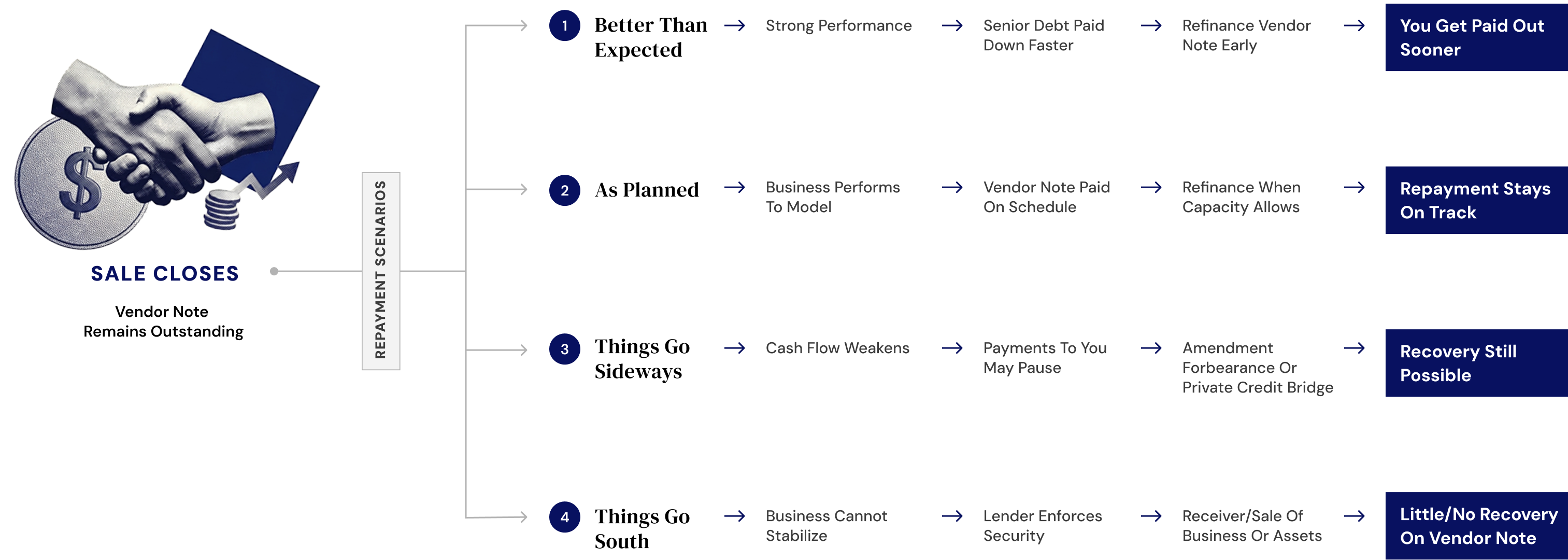
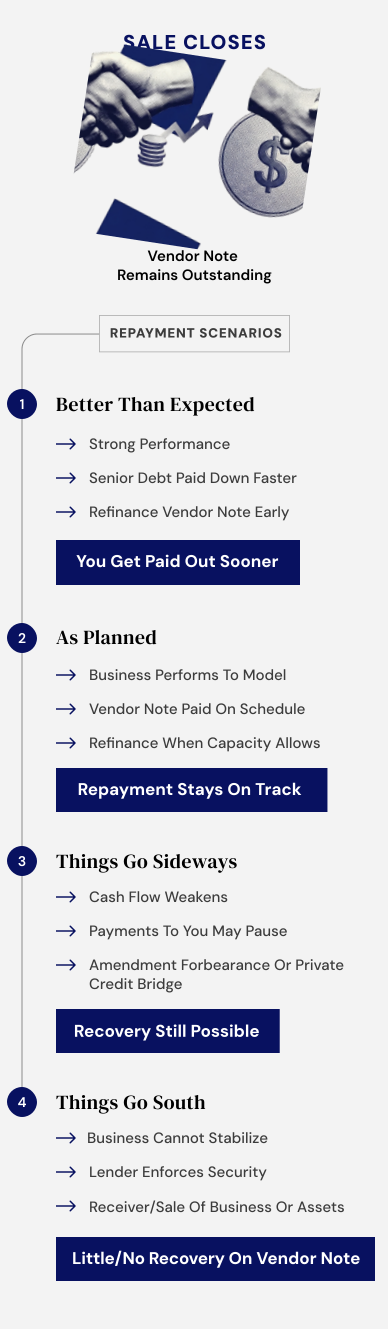
Sellers should remember that if they are carrying a vendor note, they are effectively acting as a lender after closing. In that context, the purchase price is only part of the equation. Sellers should consider protections such as security over the acquired shares and the assets of the business, personal guarantees, information and reporting rights, and clearly defined default remedies.”
Partner, Cassels
Reach out to Winta on LinkedIn



If I looked at a management buyout strictly through a financial lens, I’d tell a lot of owners to sell to someone else. Management usually brings very little capital, the bank only funds what it can comfortably underwrite, and you can end up accepting a lower price while financing part of the purchase yourself from behind the lender. We’ve seen enough of these deals to know that concessions can be expensive.
Our modelling suggests the average seller may leave roughly $1 million on the table compared with the best available outside-sale alternative.
That is too much money to give away casually because selling to management feels like the right thing to do.
And yet these are some of my favourite transactions, because there is more to a business than the cheque you get when you leave. When an owner is willing to give a trusted operator the chance to take over, and that person is willing to put their own money and future behind the belief that they can run it, I want to see that work. Canada needs more ambitious people willing to take the risk of ownership and build wealth by operating businesses, not fewer. My issue is when an owner makes that concession and then gives away another pound of flesh through a bad structure, unnecessary seller exposure or financing terms they never understood. If you decide continuity is worth something, make that trade deliberately and make damn sure you are not paying for it twice.

Grant Daunheimer, CFA
Partner at Diamond Willow
An MBO lets you choose who owns the business next, but that choice can come with a lower price, less cash at closing and years of continuing financial exposure. Diamond Willow’s role is to make sure you do not give up more than that succession decision requires.
We work out what the business can support, how much of the purchase can reasonably be financed by a bank, where seller financing is necessary and how the transaction should be structured before those decisions become difficult to change. The objective is a deal management can afford, lenders can underwrite, and you can walk away from with as much cash and as little continuing risk as the structure allows.


Bring us into the conversation while the price and financing structure are still being worked out. We can help determine what lenders are likely to support, identify issues before the transaction reaches the bank and work alongside the owner’s legal, accounting and M&A advisors through the financing process.


If you want more of the thinking behind Canadian business borrowing, Debt Digest looks at lending conditions, transactions and what they mean for companies making financing decisions.