
Debt Digest

We do the research so you don't have to.
October 2022
VOLUME 29
Download PDF

October 2022

CAPITAL IS AVAILABLE IN CANADA BUT SIGNS OF TIGHTENING ARE APPEARING…

Over the past several months it has become increasingly more difficult to find anything in the news that doesn’t predict ‘Economic Armageddon’. While it is evident that economic conditions are tightening, it appears that Canadian businesses continue to have access to debt capital. That being said, those businesses who need additional capital flexibility are advised to seek out options sooner than later.

In Q3/2022, the Canadian Big 6 Banks facilitated a continued expansion of commercial credit facilities, collectively growing their loan book by 18% Y/Y. In addition, Credit Loan Loss Provisions continue to be well-below pre-COVID levels by ~40%, on average, but are seeing a slight uptick compared to prior post-COVID quarters. So, what’s going on with The Big 6 and will these trends continue given mounting economic pressures? Read on to see our thoughts.

Our Thoughts: While lending activity from the Big 6 has increased 18% Y/Y, there is evidence of a decelerating trend, meaning less credit capital is being underwritten as time goes on. In combination with this tightening of the purse strings, banks are increasing their loan loss provisions. We expect this trend will continue and any borrowers who are in need of more flexible capital are advised to quickly evaluate other lending partners such as the ~350 alternative lenders in the DWA network.

THE BACKUP DATA

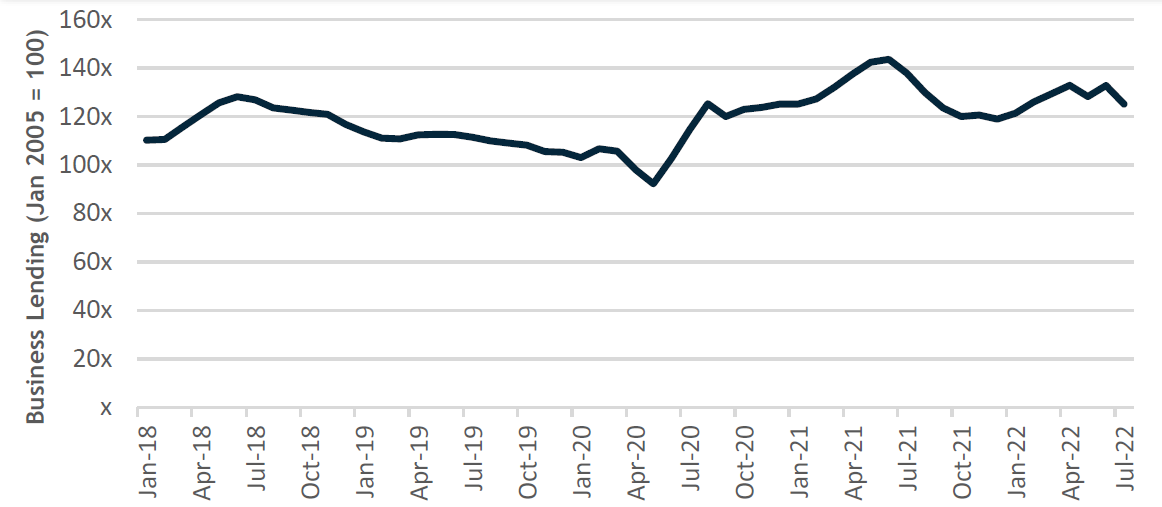
Canadian Small Business Lending Index: On aggregate, the CSBLI has increased 27% since April 2020 but has regressed since its June 2021 high. Manufacturing and Retail continue to experience growing lending activity (6% and 18 % increase Y/Y, respectively based on July 2022 figures), while Agriculture is showing a decline in lending activity (-17% Y/Y based on July 2022 figures).

Canadian Small Business Lending Index, Jan 2018 - Jul 2022
THE BIG 6 CONTINUE TO EXPAND THEIR COMMERCIAL LOAN BOOK

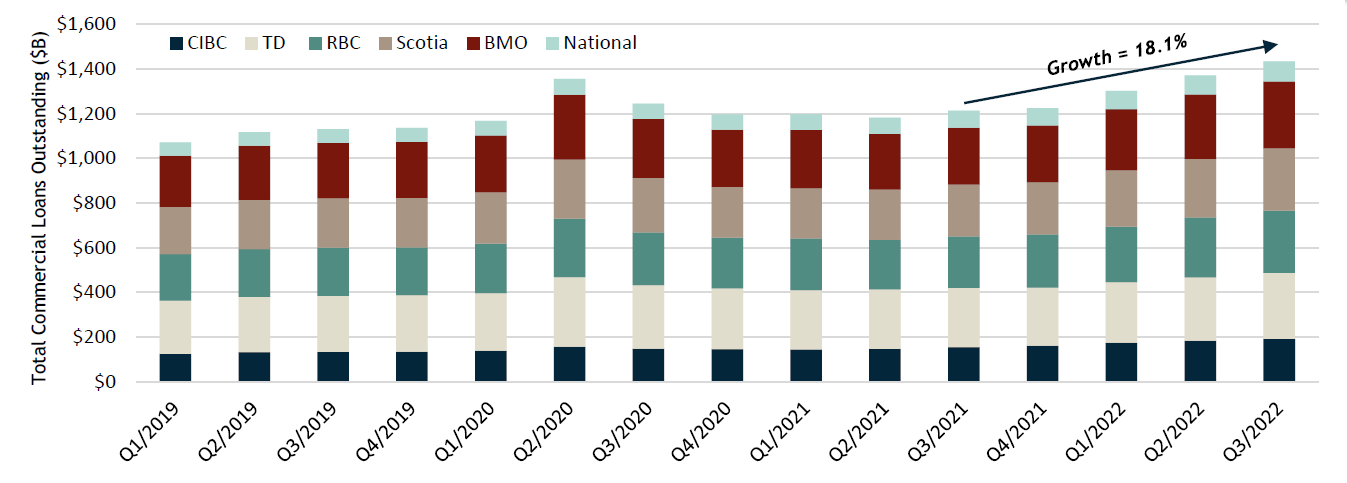
The main Canadian lenders pivoted their loan appetite in Q3/2021 and haven’t looked back. Since then, overall loan growth has increased 18%. While this growth in credit has been critical to assisting Canadian businesses navigate out of COVID, loan growth in Q3/2022 is beginning to demonstrate a continued deceleration trend compared to prior quarters. Q/Q% growth in Q3/2022 was only 4.6% compared to 5.3% in Q2/2022 and 6.3% in Q1/2022. Given the aggressive monetary policy instituted by the Bank of Canada, we expect this deceleration trend to continue into the future. Interestingly, the timing of the growth in The Big 6’s loan book perfectly matches historical trends – after the crash in 2008, it took 5 quarters before The Big 6 begin increasing their loan book.

The Big 6: Total Loans Outstanding, Q1/2019 - Q3/2022
GROSS IMPAIRED LOANS CONTINUE TO DECLINE

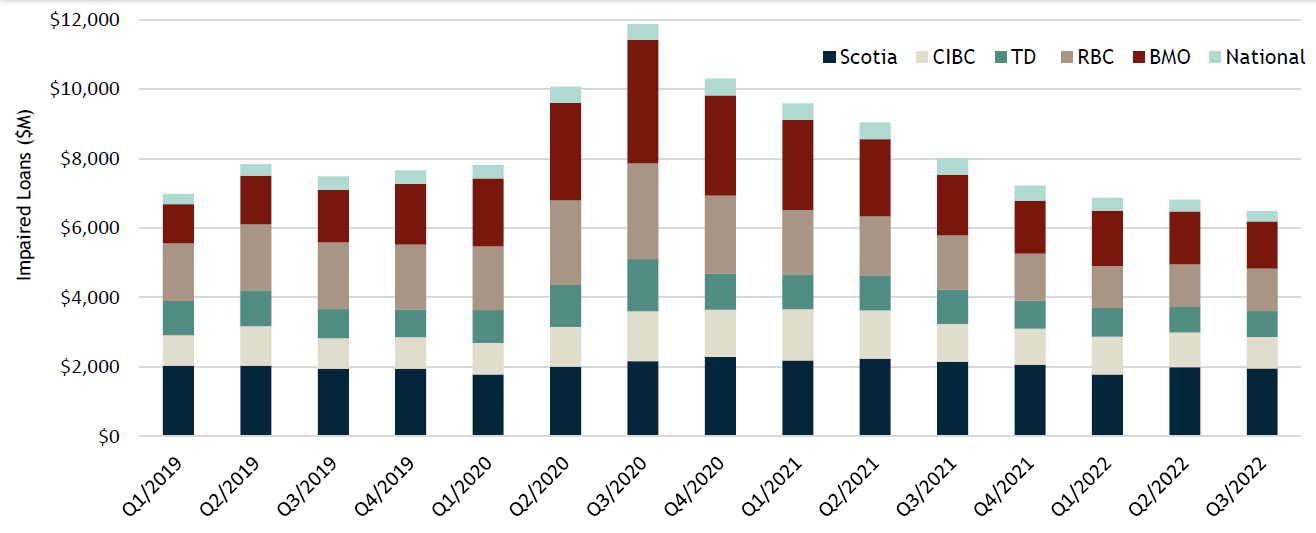
Gross impaired loans have continued to normalize back to and below pre-COVID levels, having decreased 5% Q/Q and 19% Y/Y in Q3/2022. On a aggregate basis, gross impaired loans now account for ~0.5% of total outstanding commercial loans provided by The Big 6 which is slightly less than the ~0.7% of total outstanding loans pre-COVID. All sectors, with the exception of the service industry (i.e. hospitality and food services), followed this aggregate trend of normalizing to or below pre-COVID levels. The service industry has marginally increased to 0.4% compared with 0.3% pre-COVID.

The Big 6: Gross Impaired Loans, Q1/2019 - Q3/2022
CREDIT LOAN LOSS PROVISIONS ARE BACK

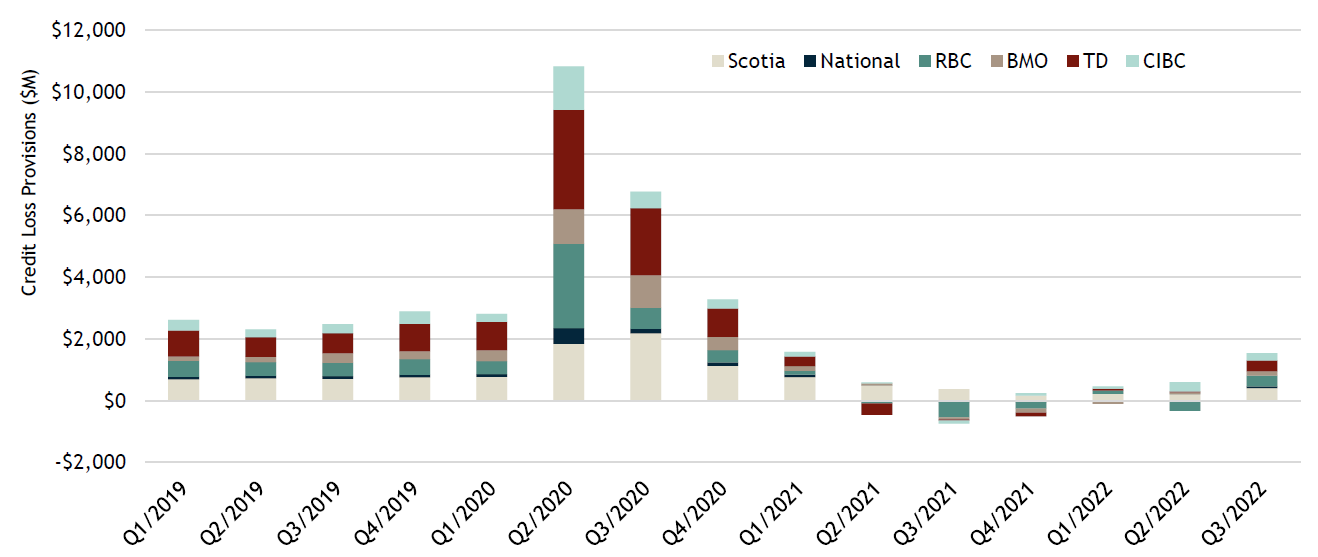
It appears that the trend of negative provisions has ended, and The Big 6 are beginning to build up an allowance amount to offset any future anticipated losses. In fact, Credit Loan Loss Provisions are up 468% Q/Q and 428% Y/Y. While a data point isn’t indicative of a trend, it is worth noting: (1) credit loan loss provisions continue to be well-below historical averages at 0.11% of total loans outstanding vs. 0.25% during the preCOVID era and (2) Stage 1 & 2 Credit Loan Loss Provisions have become positive, which is largely driving the increase. The Big 6’s Q4 earnings report will provide more detail on whether this uptick will continue.

The Big 6: Credit Loan Loss Provisions, Q1/2019 - Q3/2022
The Big 6: Select Industries Total Credit Outstanding vs. Impaired Loan %, Q4/2013 - Q3/2022

AGRICULTURE LENDING UP, IMPAIRED LOANS DOWN

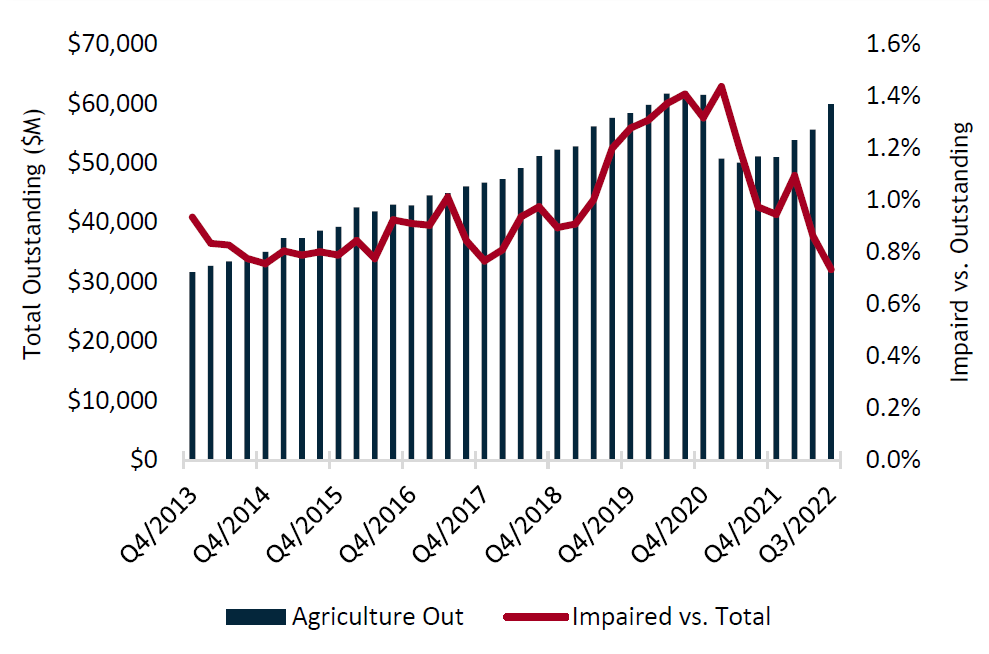
Unlike the overall trend in Canadian Small Business Lending, the Big 6 have increased the size of their agriculture loan book by 17% YoY. This is likely attributed to lending to larger operations, which often have more disposable capital and collateral for expansion activity. In addition, this trend largely supports the continued pressure on the agriculture industry to produce more in the wake of the Ukrainian war.

The Big 6: Agriculture Total Credit Outstanding vs. Impaired Loan %, Q4/2013 - Q3/2022
NO MORE RETAIL AND WHOLESALE LENDING DROUGHT

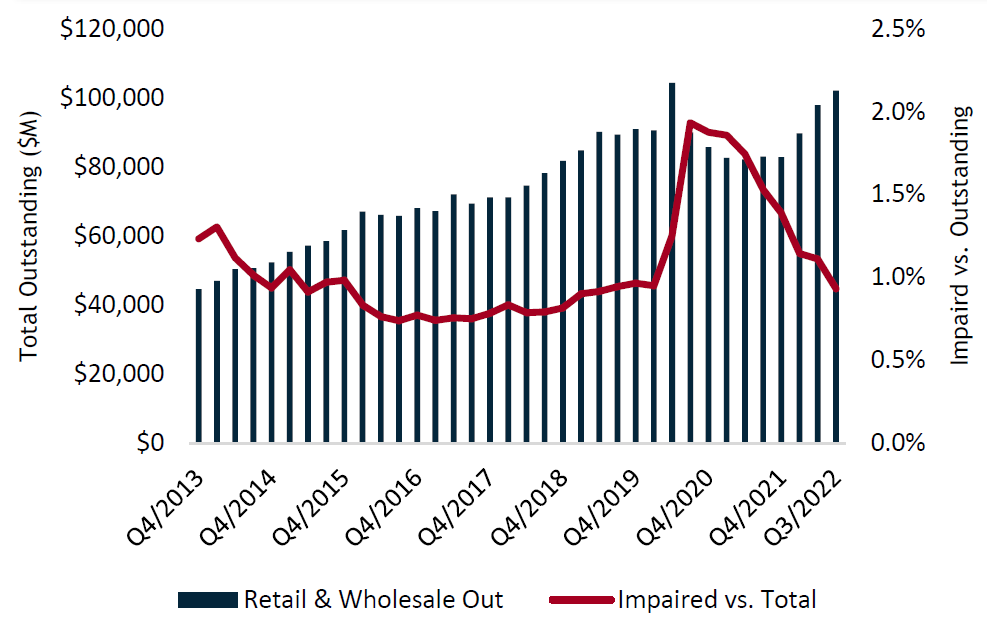
Retail and wholesale lending continues to be healthy and normalizing to pre-COVID levels. Y/Y growth from the Big 6 was 23% compared with 18% from the Canadian Small Business Lending Index. Impaired loans continue to decline to pre-COVID levels of sub-1%. It appears that the expansion efforts of several retailers, both big and small, are being supported by the Canadian Big 6 Banks and lenders across the country alike.

The Big 6: Retail & Wholesale Total Credit Outstanding vs. Impaired Loan %, Q4/2013 - Q3/2022
MANUFACTURING IS MAKING A COMEBACK

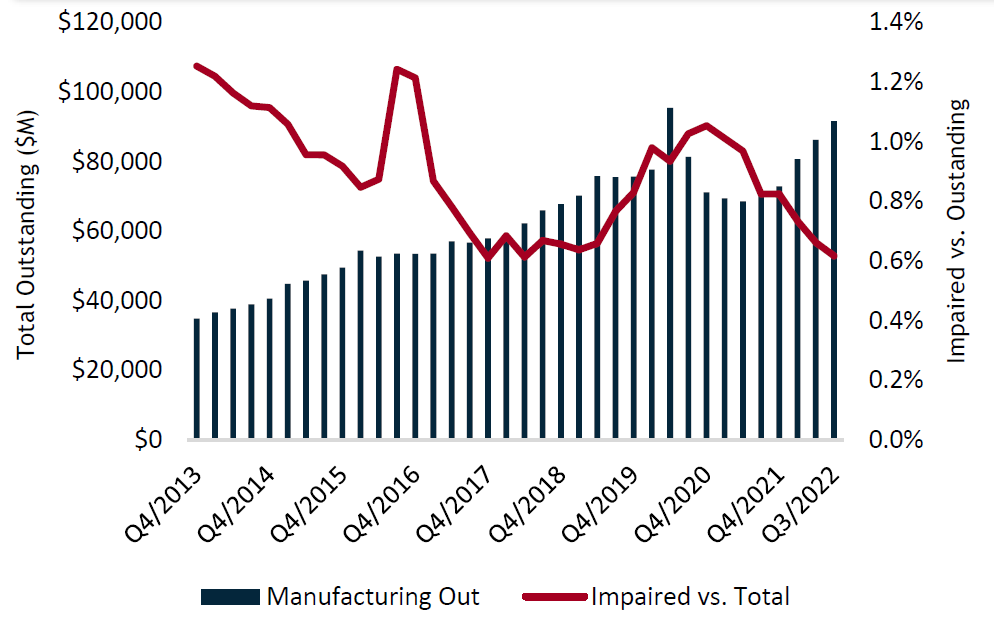
Canadian finished product manufacturing is up 16% Y/Y as of July 2022, so it follows that lending activity in the space has also rebounded. On a Y/Y basis, lending in the space has increased 29% and impaired loans have been reduced to a normalized pre-COVID level of 0.6%.

The Big 6: Manufacturing Total Credit Outstanding vs. Impaired Loan %, Q4/2013 - Q3/2022
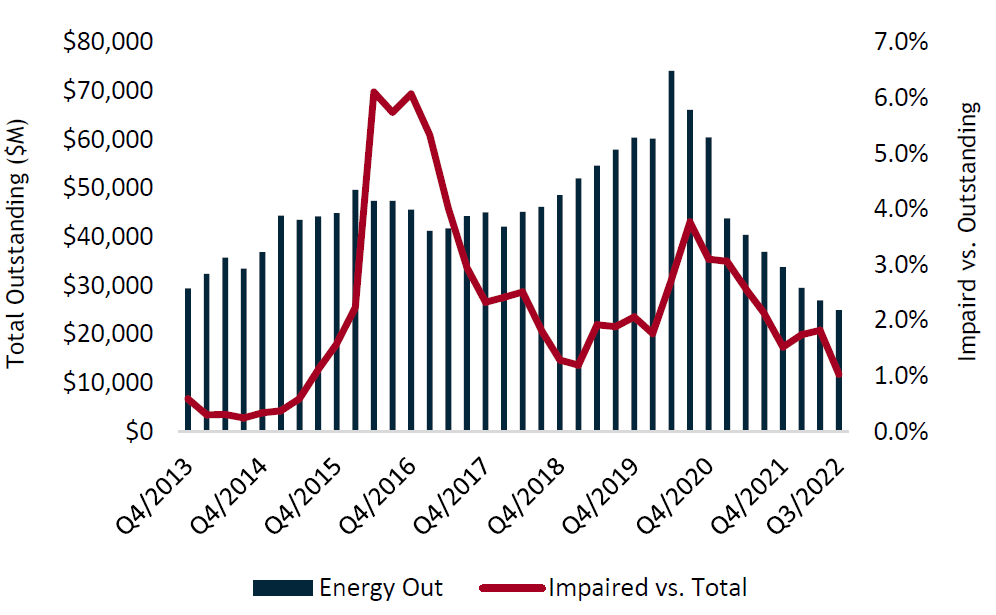
ENERGY CONTINUES TO DECLINE

Capital availability for energy continues to decline, which largely support the Big 6’s overall strategy of transitioning away from non-renewable lending. Loans outstanding declined by 32% Y/Y, while impaired loans also declined to sub-1%. Energy companies likely aren’t feeling the pinch like they were pre-COVID due to the elevation in energy prices, but these companies will likely have to navigate a difficult capital landscape if this trend was to reverse.

The Big 6: Energy Total Credit Outstanding vs. Impaired Loan %, Q4/2013 - Q3/2022
Sources: PayNet, Company Reports, Diamond Willow Advisory.

October 2022
VOLUME 29
Download PDF

More Debt Digests

We Do Our Research.

All Debt Digests
VOLUME 20
January 2021
Locked and Loaded
Private Capital & Dry Powder
Keep Reading
VOLUME 44
May 2024
A Fiscal Feast: Digging Into Canada's Provincial Budgets
Keep Reading
VOLUME 43
April 2024
From Eh to Nein: Comparing Canada to the G7
Keep Reading
VOLUME 40
December 2023
An Update on Canadian Debt Markets
Keep Reading
VOLUME 42
February 2024
Canadian Bankruptcy & Insolvencies Are On the Rise
Keep Reading
VOLUME 41
January 2024
Addressing Canada’s Demographic Challenge
Keep Reading
VOLUME 39
October 2023
Canadian M&A Market Update: Down But Not Out
Keep Reading
VOLUME 38
September 2023
Q3 Bank Earnings: What Does It Mean For Borrowers?
What Does Q3 Bank Earnings Mean For Borrowers?
Keep Reading
VOLUME 37
August 2023
There and Back Again: A Look at Canadian Inflation
Keep Reading
VOLUME 34
March 2023
The Inflation Saga: Are Rate Hikes Working?
12-months after the first hike, the economy is sending mixed signals.
Keep Reading
VOLUME 36
June 2023
Looming Storm Clouds? An Update On Canadian Insolvencies
Looming Storm Clouds? An Update on Canadian Insolvencies
Keep Reading
VOLUME 35
May 2023
Canadian Real Estate: Sending Mixed Signals
Keep Reading
VOLUME 33
February 2023
Canadian Farmers are Having Their Day in the Sun
Strong commodity prices, near-record crop yields, have the stars aligned?
Keep Reading
VOLUME 32
January 2023
How Business Owners Can Prepare for Economic Weakness
Preparing your business for economic weakness
Keep Reading
VOLUME 31
December 2022
UPDATE: Q4 Bank Results Continue Trend of Tightening
Loan Growth Slowing, Loss Provisions Rising
Keep Reading
VOLUME 28
August 2022
Where, Oh Where Did All the Job Seekers Go?
Great employees create opportunity, but they’re hard to find…
Keep Reading
VOLUME 29
October 2022
What Q3 Bank Results Mean for Borrowers
Capital is available in Canada but signs of tightening are appearing
Keep Reading
VOLUME 30
November 2022
Winners & Losers In a Strong US Dollar Environment
A strong US Dollar inpacts Canadian business, but who is most impacted?
Keep Reading
VOLUME 26
December 2021
Best Offense is a Good Defense
Ensure your balance sheet is in a position to weather the storm
Keep Reading
VOLUME 27
June 2022
Prepare for Landing… Could be Soft, Hard, or We Might Crash
Prepare for landing…could be soft, hard, or we might crash
Keep Reading
VOLUME 25
June 2021
Q2 2021 Canadian Bank Results
Loan Losses Down, Commercial Credit Flat, Mortgages Continue to Ram
Keep Reading
VOLUME 24
May 2021
Dolla, Dolla Bills
Follow the money to see the rising tide floating all boats
Keep Reading
VOLUME 23
April 2021
Capital Markets - SO HOT RIGHT NOW
Follow the money to see the rising tide floating all boats
Keep Reading
VOLUME 20
February 2021
The Stars are Aligned
Mid-market M&A Outlook
Keep Reading
VOLUME 21
March 2021
Q1 2021 Canadian Bank Results
On the other side of a tight credit market
Keep Reading
VOLUME 22
March 2021
Moving Parts of the Secondary Equipment Market
Get the low down on the ever-changing dynamics of hard asset values across Canada and into the United States.
Keep Reading
VOLUME 18
December 2020
Highlights from Q4 2020 Bank Results
Results Indicate Lending Tide is Turning
Keep Reading
VOLUME 19
December 2020
A Few of Our Favourite Ramblings
Results Indicate Lending Tide is Turning
Keep Reading
VOLUME 14
September 2020
Feeling Insecure with your Security?
Holding our breath as we wait for new data points
Keep Reading
VOLUME 12
July 2020
Keep Reading
VOLUME 16
October 2020
Debt Funding for Canadian Small Business
A look at debt funding for small business in Canada
Keep Reading
VOLUME 15
October 2020
For Business Owners and Entrepreneurs - What to do when the Bank says “No”
Guidance for business owners and entrepreneurs on how to secure capital from non-traditional lenders.
Keep Reading
VOLUME 17
November 2020
The Canadian Energy Transition, Beyond the Headlines
A look at the present and future of Canadian Energy.
Keep Reading
VOLUME 13
September 2020
Keep Reading
VOLUME 11
June 2020
You Down With ESG? Yeah, You Know Me.
ESG Coming to the Private Debt World
Keep Reading
VOLUME 10
June 2020
The Changing Dynamics of Commercial Borrowing
We look into the commercial lending landscape in Canada
Keep Reading
VOLUME 07
March 2020
Keep Reading
VOLUME 09
April 2020
Break On Through To The Other Side
Data Analytics likely a big winner in post pandemic world
Keep Reading
VOLUME 06
February 2020
The economic ripple effect of the Coronavirus
It’s a small, interconnected world
Keep Reading
VOLUME 04
December 2019
Uncertainty Breeds Opportunity
Flushing out impaired loan trends in Canada’s Banking Sector
Keep Reading
VOLUME 05
January 2020
Keep Reading
VOLUME 03
November 2019
Welcome to Peak Negativity
A look at how the Calgary economy has changed since the downturn
Keep Reading
VOLUME 57
February 2026
2025 Canadian Bank Loan Book Analysis
2025 was a banner year for the Canadian Big 6 Banks, who all posted solid loan growth with stable...
Keep Reading
VOLUME 45
July 2024
Banking Bull Riders: Canadian Banks Manage the Storm
With a flurry of recent developments at Canada’s Big 6 Banks, including RBC’s acquisition of HSBC...
Keep Reading
VOLUME 46
August 2024
How Low Can You Go? Was the Latest BOC Rate Cut Warranted?
The BOC recently cut its key policy rate to 4.5% (from 4.75%), leading the US and ECB who have yet to cut...
Keep Reading
VOLUME 47
September 2024
What We are Watching: Key Economic Indicators
With summer behind us and the kids back in school, it seems like the perfect time to take a closer look at...
Keep Reading
VOLUME 48
October 2024
The Power Play: AI Data Centers Taking Over the Power Grid
Other than the US election, AI and data centers have been dominating the news with global giants such as...
Keep Reading
VOLUME 49
December 2024
Are You Tariffing Me? Industries Most Impacted By a Trade War
In the latest chapter of the US/Canada relationship, the US has suggested that it would impose a 25% blanket tariff...
Keep Reading
VOLUME 50
January 2025
The Great Canadian Business Transition… and Opportunity
The topic of business transition has garnered significant attention over the past several years — and for good reason...
Keep Reading
VOLUME 51
February 2025
Soft as a Delta Flight Landing: Canadian Insolvencies & Q1 Bank Earnings
Canadian businesses faced continued macroeconomic pressures in 2024 as corporate insolvencies increased by...
Keep Reading
VOLUME 52
April 2025
Was This Really a Lost Decade for Canada? Sadly, Yes.
Over the past decade, global economies have experienced uneven growth trajectories shaped by demographic shifts...
Keep Reading
VOLUME 56
November 2025
O Canada, We Are In Major Financial Trouble
Canada’s federal deficit is projected to add roughly $322 billion over five years. Government operating costs...
Keep Reading
VOLUME 53
May 2025
Collateral Confidence: Asset Values Resilient Despite Softening
In today’s media landscape, it can feel like everything is labeled a “crisis” but it’s worth remembering what true crises...
Keep Reading
VOLUME 54
June 2025
Playing Hard to Get - Canadian Debt Markets
While debt capital remains available, banks are tightening underwriting standards, and private credit is expanding,...
Keep Reading
VOLUME 55
October 2025
A Pivotal Moment for Canada: Diversify or Continue to Suffer
Canadian capital markets must evolve—without diversification of industry, investment, and exports, Canada risks...
Keep Reading